How to Use AI for a Mindful Pause

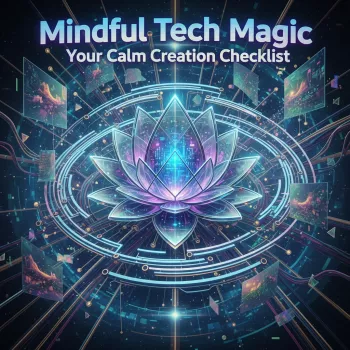
A quiet pause does not have to mean putting every device away. You might use AI to find a gentle starting cue, then set your phone aside and pay attention to your own experience. Our Mindful Tech Magic: Your Calm Creation Checklist is a $5.99 digital download for exploring mindful living, meditation, and calm with AI. Let it give your exploration some structure while you decide what feels useful to you.
Start with the kind of calm you need
Consider an ordinary moment: a crowded morning, a break between tasks, or the trip from work to home. You do not need to redesign your day. Choose one moment when a brief pause would be welcome, and give it a simple intention. You might notice your breathing, feel your feet on the floor, or name what is on your mind. The point is to practice paying attention, not to achieve a particular mood.
If you would like a starting cue, keep the request small. The ideas below are examples you can try on your own; they are not a list of materials included in the checklist.
| When you have | Try this intention | How AI might help |
|---|---|---|
| A brief break | Notice your breathing | Ask for a short, gentle breathing cue |
| A change of pace | Let go of the previous task | Ask for a simple transition ritual |
| Time to reflect | Name what is on your mind | Ask one open-ended reflection question |
Let AI offer a cue, not take over the practice
AI can suggest where to begin, but it cannot decide what calm should feel like for you. A response that sounds helpful on one day may feel distracting on another. You can skip it, shorten it, or change it without getting the practice “wrong.” The noticing is yours to do.
For example, you could ask: “Suggest a two-minute mindfulness pause using plain language, with no promises about how I will feel.” Adapt those words to suit your time and preferences. Once you have a cue, try looking away from the screen. Notice the sounds around you, the support of your chair, or the feeling of your feet on the ground. If you spend the entire pause reading and adjusting the response, the tool may be taking more attention than it gives back.
Mindfulness is a practice, not a guaranteed way to feel better on demand. For background on its potential benefits and limitations, see the National Center for Complementary and Integrative Health’s overview of meditation and mindfulness.
Build a small routine you will want to repeat
Try a four-part rhythm: choose your moment, request one cue if it would help, practice for a comfortable amount of time, and notice what worked. That last step can be as simple as recognizing that a shorter pause fits your day better. You do not need to score the experience or turn it into another task.
When possible, silence notifications before you begin. If opening an AI tool draws you into messages or more screen time, keep the same intention and leave the device out of it. You can take three unhurried breaths without asking for instructions. Consistency matters more than assembling a perfect meditation session, and a routine is easier to repeat when it leaves room for your real life.
We offer the Mindful Tech Magic checklist as one way to give that exploration a little structure. If reflection becomes the part you most want to explore, our How to Use AI for Self-Discovery Exercises digital guide is another option. You can choose the resource that matches your interest without adding more tools to a pause that already works.
Keep your reflections personal
You do not need to share sensitive experiences, names, or identifying details to ask an AI tool for a breathing cue or a general reflection question. A request such as “Give me one question to help me reflect on my day” can stay broad. Before entering journal-style thoughts, review the tool’s privacy settings and consider whether you would rather write those thoughts privately on paper. The Federal Trade Commission’s consumer privacy resources can help you make more informed decisions about what you share online.
Keep a boundary around what this practice can do. Meditation tools may support a wellness routine, but they are not a substitute for professional mental health care. If a pause brings up distress, you can stop, return your attention to your surroundings, and seek appropriate support. Taking care of yourself also means choosing not to continue a practice that feels overwhelming.
Make your next calm moment easy to begin
Pick one ordinary moment today and try a brief, flexible pause. You can use a cue, change it, or leave the screen behind entirely. If you want a straightforward companion for exploring meditation and calm with AI, our Mindful Tech Magic: Your Calm Creation Checklist is ready as a digital download. Start with what fits, then let your own experience guide what you repeat.
FAQ
Do I need meditation experience to use a mindful living checklist?
No. You can begin with a short pause and a simple intention, then adapt any AI-generated cue to your comfort level.
Can AI meditate for me?
No. AI can suggest a cue or reflection question, but you do the noticing and practicing. It is fine to put your device down once the pause begins.
Should I share personal journal entries with an AI tool?
Not necessarily. A general, non-identifying request may be enough; review the tool’s privacy settings and keep sensitive reflections offline if you prefer.



Leave a comment